
- This event has passed.
尺八 & 一弦琴 コンサート: DISCOVERY IN A SINGLE TONE
October 8日, 2017 @ 4:00 pm - 5:30 pm UTC+0
$25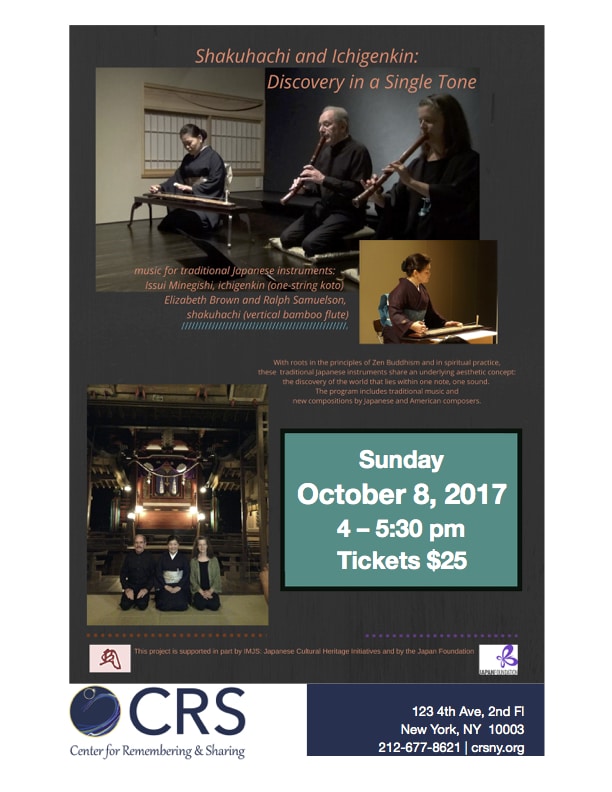
10月のコンサートは、清虚洞一絃琴宗家四代 峯岸一水さんによる一絃琴と、ラルフ・サミュエルソン、エリザベス・ブラウン二人の尺八奏者をお迎えします。
一絃琴とは、もともと高僧・貴族・武士・文人達によって主に精神修養のために弾かれた楽器で、一本の絃だけの琴で「人に聴かせるためではなく、自分の心のために演奏するもの」としてたしなわれていました。
今回のプログラムは古典とともに新曲が演奏され、そのなかには、短歌をもとに、2011年の東日本大震災の遺族へ捧げる、Elizabeth Brown作曲の「秋廻り来て」も含まれます。心の琴線に触れる尺八・ 一弦琴のコラボレーションの響きを、どうぞお楽しみ下さい。
チケットは9/30日までのご購入で $20、当日 $25です。オンライン、 またはお電話(212-677-8621)でも受け付けています。
Ideally, this music is heard in a tranquil setting conducive to calm, focused listening. The ichigenkin’s philosophy of “one string” is a natural partner to the “one note” aesthetic of the shakuhachi, and while the shakuhachi is becoming more familiar to audiences around the world, opportunities to hear the ichigenkin are truly rare. Largely through the efforts of Minegishi Issui, the ichigenkin is gradually finding a new place in contemporary Japan and abroad. This trio of musicians, two from America and one from Japan, presents numerous concerts in Japan. Now they are bringing knowledge of these beautiful instruments and their music to an American audience.
This concert is part of a 12-stop U.S. tour. This project is supported in part by IMJS: Japanese Cultural Heritage Initiatives and by the Japan Foundation.


About the Performers
 Minegishi Issui is the 4th Iemoto, or heir, of the Seikyo-do Ichigenkin Tradition. The Seikyo-do follows the idea of Zen practice, which removes all unnecessary vanities. She was trained by her great-grandmother, the 3rd heiress, an officially designated Intangible Cultural Treasure of Japan. Minegishi Issui succeeded to the title of 4th Iemoto in 1988, and was honored as Graduate of the NHK Conservatory of Japanese Traditional Music. She has performed around the world. At her 2008 Kioi Hall concert in Japan, she was honored with the presence of Her Majesty the Empress of Japan, Michiko. Minegishi Issui won the bronze prize in the division “1-2 string musical instruments” at Delphic 2009 (The Art and Cultural Olympic Games) in Jeju, Korea. She received Asian Cultural Council grants in 2010 and in 2013.
 Ralph Samuelson, a performer and teacher of the Japanese bamboo flute, shakuhachi, was trained in the classical tradition of the Kinko School of shakuhachi by the late Living National Treasure Goro Yamaguchi as well as by Shudo Yamato and Kodo Araki V, both in Japan and in the graduate world music program at Wesleyan University. He performs traditional and contemporary music throughout North America, Asia, and Europe, and has recorded for Innova, CBS Masterworks, Lyrichord, Music of the World, Tzadik, XI Records, Pogus, and other labels. He was shakuhachi soloist in the New York City Ballet production of Jerome Robbins’ “Watermill”, and his annual “Flutes of Hope” concert, commemorating the victims of the earthquake/tsunami in Japan, has been presented in New York’s Carnegie Hall and the Cathedral of St. John the Divine. In 2011 and 2013 he was artist in residence at the Lou Harrison House in Joshua Tree, California. He is an international advisor for the Seoul Institute of the Arts in Korea and is senior advisor and former director of the Asian Cultural Council.
 Elizabeth Brown combines a composing career with a diverse performing life, playing flute, shakuhachi, and theremin in a wide variety of musical circles. She is celebrated both here and in Japan for her compositions combining eastern and western sensibilities. A Juilliard graduate and Guggenheim Fellowship recipient, her music has been heard in Japan, the Soviet Union, Colombia, Australia, South Africa and Vietnam as well as across the US and Europe. She has received grants, awards and commissions from Orpheus, St. Luke’s Chamber Ensemble, Newband, the Asian Cultural Council, the Japan/US Friendship Commission, Meet the Composer, the Electronic Music Foundation, the Cary Trust, and NYFA. She has two solo CDs: Elizabeth Brown: Mirage (New World) and Blue Minor: Chamber Music by Elizabeth Brown (Albany), and her music is also available on CRI, Innova, and Music and Arts. http://elizabethbrowncomposer.com